
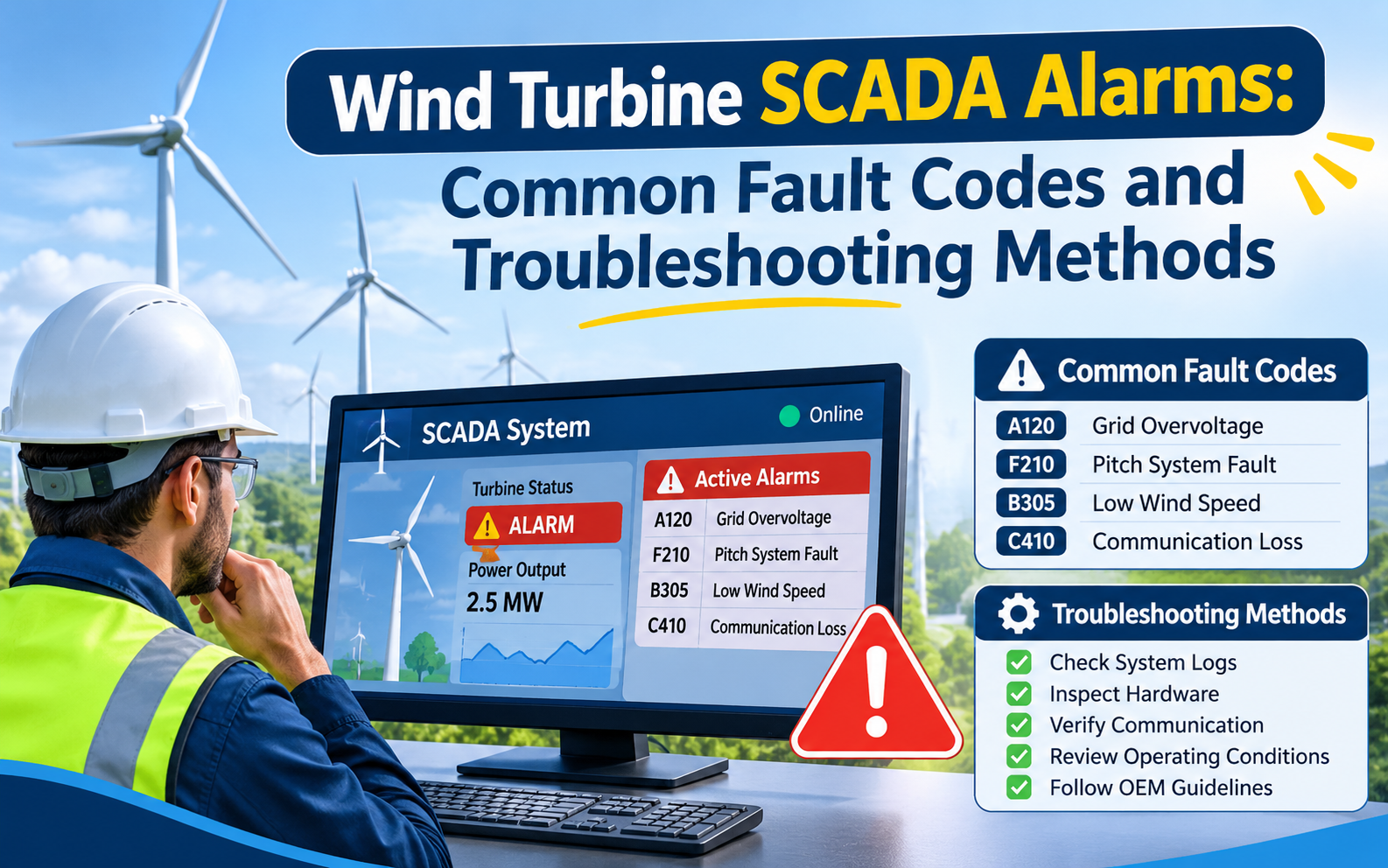
Wind Turbine SCADA Alarms: Common Fault Codes and Troubleshooting Methods
Decode Wind Turbine SCADA Alarms fast. Learn common fault codes, root causes & proven troubleshooting steps from GEISPL's renewable energy experts. Talk to us today.
Introduction
A single unresolved Wind Turbine SCADA Alarm can cost a wind farm operator thousands of rupees in lost generation every hour. With hundreds of sensors feeding data into a wind turbine SCADA system, alarms pile up fast, and without a clear troubleshooting method, O&M teams end up chasing symptoms instead of root causes. This guide breaks down the most common wind turbine fault codes, what triggers them, and the exact diagnostic steps experienced SCADA engineers use to clear them quickly and safely.
What Is a Wind Turbine SCADA Alarm?
A wind turbine SCADA alarm is a signal generated by the SCADA Alarm Monitoring system when a sensor reading, component status, or control parameter crosses a predefined safety or performance threshold. These alarms are logged with Wind Turbine SCADA Alarm Codes that map directly to specific subsystems: gearbox, converter, generator, pitch, yaw, or grid interface.
Why Wind Turbine Fault Codes Matter for O&M
Modern Wind Turbine Condition Monitoring platforms generate huge volumes of alarm data. Industry data suggests unplanned downtime from gearbox, generator, and converter failures accounts for a significant share of total O&M costs across wind farms. Fast, accurate SCADA Fault Detection directly protects:
- Availability and PLF (Plant Load Factor)
- Warranty and insurance claims
- Component lifespan through early intervention
- Predictive maintenance scheduling accuracy
Common Wind Turbine SCADA Alarm Categories
1. Generator and Converter Faults
Wind Turbine Generator Faults and Wind Turbine Converter Faults often trigger over-temperature, insulation resistance drops, or IGBT overcurrent. Troubleshooting method: check cooling fan operation, verify ambient temperature logs, and inspect converter cabinet filters before replacing electronics.
2. Gearbox and Vibration Alarms
Wind Turbine Gearbox Faults usually appear as high oil temperature or Wind Turbine Vibration Alarms from accelerometers. Troubleshooting method: cross-check oil cooler flow rate, oil contamination levels, and bearing vibration trend data to distinguish a sensor fault from an actual mechanical issue.
3. Sensor and Communication Errors
Wind Turbine Sensor Faults and Wind Turbine Communication Errors (PLC-to-SCADA dropouts) are frequently mistaken for real equipment failures. Troubleshooting method: reset the communication link, check cable terminations, and verify PLC firmware before escalating to a hardware swap, this alone eliminates a large share of false-positive alarms.
4. Grid Connection and Protection Faults
Wind Turbine Grid Connection Faults, voltage ride-through trips, frequency deviation, or reactive power limit alarms, need grid code compliance verification alongside SCADA logs.
5. Emergency Shutdown and Temperature Alarms
Wind Turbine Emergency Shutdown Alarms and Wind Turbine Temperature Alarms are safety-critical and should never be bypassed. Troubleshooting method: always confirm the root trigger in the historian before any manual reset.
Wind Turbine Alarm Troubleshooting Workflow
- Acknowledge and log the SCADA alarm with timestamp and turbine ID
- Check the alarm history for repeat occurrences or cascading faults
- Cross-reference sensor trends (temperature, vibration, current) before the trip
- Isolate the subsystem — control, electrical, mechanical, or communication
- Apply the OEM fault code table to narrow down the probable cause
- Test and reset only after root cause is confirmed, not just cleared
- Document corrective action for predictive maintenance trend analysis
Why This Matters for Wind Turbine SCADA Monitoring
A well-tuned SCADA Alarm Management strategy reduces nuisance alarms, prioritizes genuine PLC fault codes, and feeds reliable data into Wind Turbine Predictive Maintenance programs, directly improving Wind Turbine Operational Efficiency across the farm.
How GEISPL Solves Wind Turbine SCADA Alarm Challenges
Based in Bangalore, GEISPL's SCADA systems and Compact SCADA solutions are purpose-built for wind energy operators who need accurate, actionable alarm intelligence, not alarm fatigue. Our Asset Management and IoT Services layer condition-monitoring sensors on top of SCADA data, the same approach used in our case study on sensor-based rotor maintenance for wind turbine generators. This overcomes the core problem most farms face: too many raw alarms and too little diagnostic clarity. Our R&D in Industrial Automation continuously refines fault-code logic so O&M teams act on real faults, faster.
FAQs
Q1. What is a Wind Turbine SCADA Alarm?
It's an automated alert triggered when sensor data or system status in a wind turbine SCADA system breaches a safety or performance threshold.
Q2. What are the most common wind turbine fault codes?
Generator over-temperature, gearbox oil pressure/temperature, converter overcurrent, communication timeout, and grid voltage ride-through faults are the most frequent.
Q3. How do you troubleshoot a SCADA communication error?
Check network cabling, PLC-to-SCADA link status, and firmware version before assuming hardware failure, most communication alarms resolve with a reset.
Q4. Can SCADA alarms predict component failure?
Yes. Trending vibration, temperature, and oil analysis alarms over time supports predictive maintenance and helps flag issues before unplanned shutdowns.
Q5. Why do wind farms get too many false SCADA alarms?
Poorly tuned thresholds and sensor drift cause alarm flooding. Proper SCADA Alarm Monitoring configuration and periodic calibration reduce false positives significantly.
Q6. How can GEISPL help with wind turbine SCADA alarm management?
GEISPL designs and supports SCADA and condition-monitoring systems tailored for wind farms, helping O&M teams diagnose faults faster and maintain higher plant availability.
Conclusion
Mastering Wind Turbine SCADA Alarms, from recognizing fault code patterns to following a disciplined troubleshooting workflow, is what separates reactive maintenance from a predictive, cost-efficient O&M strategy. If your team is struggling with alarm fatigue or unreliable fault diagnosis, GEISPL can help you build a smarter SCADA monitoring setup.
Get in touch: geispl.in/#contact | ???? 080-4160-1403 | ✉️ reachus@geispl.in
D38, 4th A Main Road, Rajajinagar Industrial Estate, Bangalore – 560010 | Open Maps
Category: SCADA